“He told me all that I ever did.”
The Samaritan Woman’s testimony, (John 4:39, ESV)
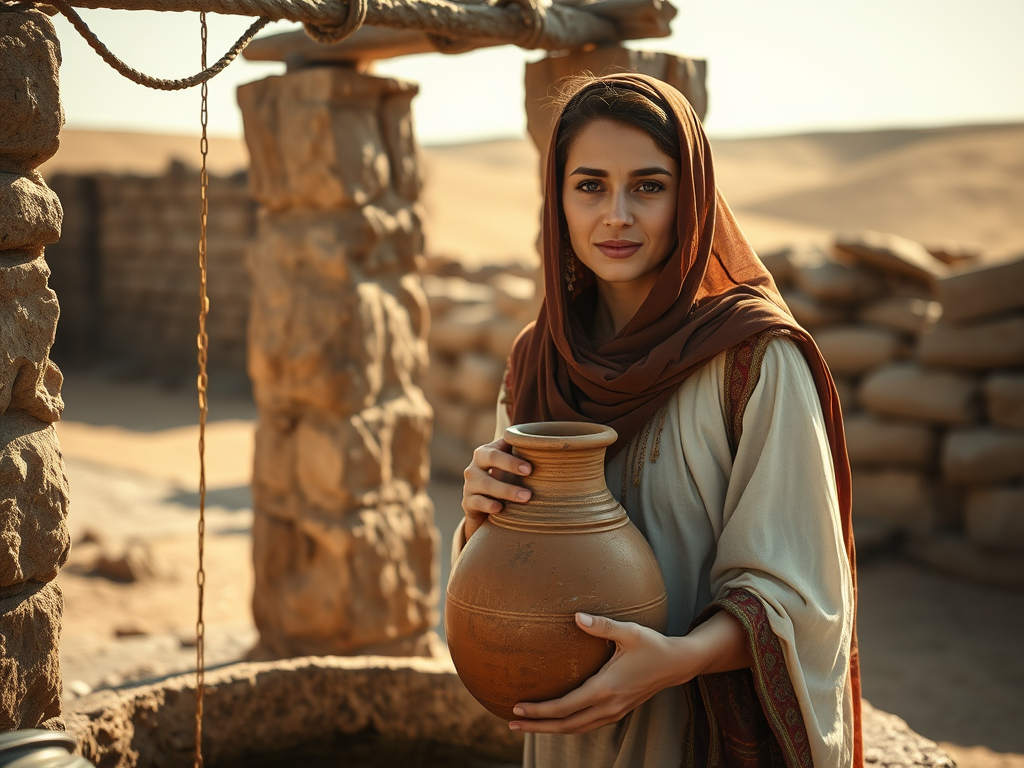
We are introduced to a Samaritan woman at Jacob’s well in John 4:1-42. The Samaritans were a mixed people of Israelite and Gentile descent. They observed only the first five books of the Bible. Jacob’s well had religious significance to the Samaritan people because it connected them to hope and life as promised in the Torah by God (John 4:12, 15; John 4:19-20, 25).
Nameless, the Samaritan woman was married five times. She was now living with a man who had no obligations to her (John 4:18). The details about her five husbands are not given to us, and we don’t know the circumstances behind her current situation. We don’t know if she has any children or family. Given the Torah laws, it is reasonable to assume that she was either abandoned or divorced by her husbands (Deuteronomy 22:20-27; Deuteronomy 24:1-4). Another possibility could have been that her husbands all died (Matthew 22:24-26). Nevertheless, we find her in John chapter four at Jacob’s well alone going about her usual business of drawing water in the heat of the day. What a symbolic imagery of her spiritual state!
In this blog post, we will be meditating on the story of the Samaritan woman and her salvation story at “the Well”.
“If you knew the gift of God, and who it is that is saying to you, ‘Give me a drink,’ you would have asked him, and he would have given you living water.”
Jesus to the Samaritan Woman (John 4:10, ESV)
Used to being ignored by most people, she found herself talking with a Jewish man who was not offended that she was a Samaritan (John 4:7,9; John 8:48). Unlike other men who paid her any attention, this man saw into her withered, worn heart and spoke with sincere compassion (John 4:10). What was this gift of God? And, was it possible for her, an abandoned and forgotten Samaritan woman, to ask for the gift of God from a Jew? This certainly went against all cultural, social, and religious parameters known to her.
“Everyone who drinks of this water will be thirsty again, 14 but whoever drinks of the water that I will give him will never be thirsty again. The water that I will give him will become in him a spring of water welling up to eternal life.”
Jesus to the Samaritan Woman (John 4:13-14, ESV)
Jesus brought to her attention the contrast between the water from Jacob’s well and the water He offers. Jacob’s well provided physical water for the temporal world, but Jesus claimed to give spiritual water for the eternal world. The Samaritan woman was physically alive but spiritually separated from God, the source of true life (Jeremiah 2:13; 17:13; John 4:20-22). Jesus revealed to her that He can connect her with God and bring life to her soul (John 3:16, 36; John 4:13-14; John 4:16-18; John 4:22-23). Upon hearing this, the Samaritan woman asked the Jew for this living water (John 4:10, 15)!
“Sir, I perceive that you are a prophet.”
The Samaritan Woman to Jesus (John 4:19, ESV)
After asking Jesus for living water, Jesus redirected her attention to spiritual matters by pointing out the fact that she has had five husbands and now living with a man who is not her husband (John 4:16-18). It was in this conversational context that Jesus made available to her His living water for eternal life. Jesus made clear to her, in a way that caught her attention, her own spiritual brokenness and bankruptcy. The Samaritan woman, cut to the heart, indeed recognized that Jesus was no ordinary Jewish man.
24 God is spirit, and those who worship Him must worship in spirit and truth.
Jesus to the Samaritan Woman (John 4:24, ESV)
Though admitting that Jesus was a prophet, because He was a Jew, the Samaritan woman had her hesitations. We see this when she brought up an important debate between the Samaritans and the Jews. Sacred places are locations of God’s manifested presence where He connected with His people. The Samaritans accepted only the first five books of the Bible; hence, it was on Mount Gerizim where they believed had significant meaning and where Moses instructed them to worship God (Genesis 12:6-7; Genesis 33:18-20; Deuteronomy 11:29; Deuteronomy 27:11-13). The Jews, on the other hand having the rest of the Old Testament, believed God’s appointed location for worship was in Jerusalem (1 Kings 9:1-3).
In response, Jesus corrected her by saying that the Jews got it right. In fact, Jesus stated that she worshipped what she did not know (John 4:22). He then told her that the debate will soon be irrelevant because the Father will have His true worshippers worshipping Him the way He had always wanted (John 4:23). Worship will no longer be limited to an earthly place because God’s dwelling will be in every sanctified heart that is spiritually alive and full of truth (Ephesians 2:22; 1 Peter 2:5).
“Come, see a man who told me all that I ever did. Can this be the Christ?”
The Samaritan Woman to the townspeople (John 4:29, ESV)
Jesus did not hold back from telling this Samaritan woman the truth about Himself (John 4:25-26). He revealed Himself plainly to her as the promised Prophet, the Messiah (Deuteronomy 18:15-22). Perhaps Jesus did so knowing she had been waiting and hoping for salvation, at the end of her rope (John 4:35). And with this enlightenment, she left her earthly water jar at Jacob’s well to tell her people all about Jesus (John 4:28). She had found the promised Savior of the world through Whom all the nations will be blessed (Genesis 22:17-18; John 4:42).
Conclusion
The salvation that this Samaritan woman found at the old well was in the Person of Jesus Christ (John 4:10, 39-42). When all others abandoned her and failed her, God showed up with truth and hope. When she was all alone, Jesus was waiting for her, unwilling for her to be left in the dark (John 1:4-5; John 4:35). He welcomed her at the well with the Gospel (Matthew 5:3-6; Mark 2:17).
Salvation is the gift of God. It is received by faith in Jesus Christ and sealed with God’s Spirit (Romans 6:23; Galatians 3:13-14; Ephesians 1:13; Ephesians 2:8; Titus 3:4-6). John stated in John 1:12-13, “But to all who did receive him, who believed in his name, he gave the right to become children of God, who were born, not of blood nor of the will of the flesh nor of the will of man, but of God.”
Jesus…He is the Giver of the gift of God (John 4:10). He is “the well” of living water. His body was beaten and hung on a tree to redeem us from the curse of the law and from lawlessness (Galatians 3:13; Titus 2:14; Hebrews 9:15). He cancelled our debt of sin (Colossians 2:14). He gives us peace with God and with others (Romans 5:1; Ephesians 2:14-17; Colossians 1:20). He is the true light that gives light to everyone (John 1:4-9).
The Samaritan woman’s testimony is that Jesus told her everything she ever did. He offered her salvation with her heart laid bare before him; nothing was hidden. With grace and mercy, Jesus meets us where we are – in our brokenness and sin. His amazing grace is able to cover all of it. And, as we drink from Jesus, we find that He is more than enough to satisfy us. To have Jesus is to experience abundant life (John 10:10).
Father, help us to know that we are welcomed at Your well of living water through Jesus. May the water You give become springs of water welling up inside of us. May our worship be in spirit and full of truth. Fill us with Your Holy Spirit for Your will and lift our burdens (Luke 11:13)!
 Redeemed Woman
Leave a comment